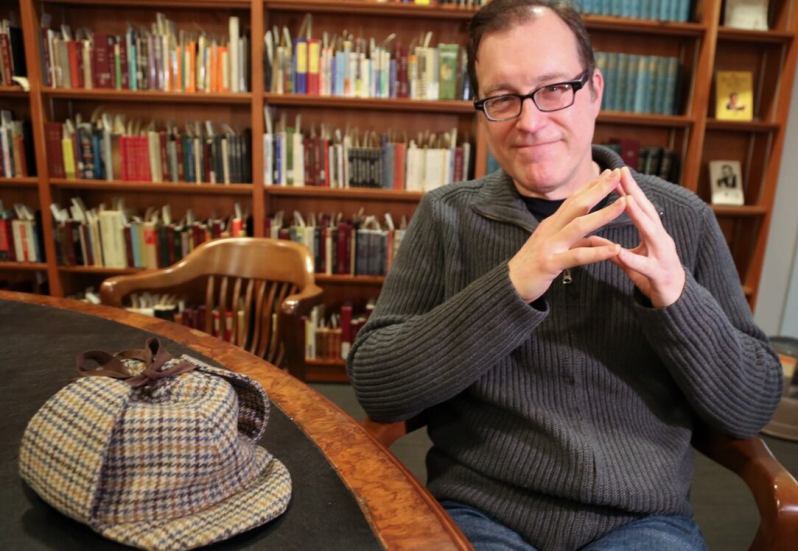
Interview with Mike Ranieri, Meyers of the club
After exploring the joyful energy of the Sherlockian Circle of Paris in our previous issue, our column, « My Club and I, » now crosses the Atlantic to meet one of the most creative societies in the Sherlockian community: the Bootmakers of Toronto. Their president, Mike Ranieri—an actor, director, and writer—shares how his passion for theatre led him to this society, which was founded in 1972. The Bootmakers’ meetings blend scholarship, humor, original songs, and parodies inspired by the sixty adventures of Sherlock Holmes. Mike reveals the story of a club that has continually reinvented its Sherlockian passion through learned traditions, unexpected collaborations, and a strong international community enhanced by the digital era. This is a warm portrait of a group that celebrates both the art of performance and the spirit of sharing.

La Gazette du 221B : Hello Mike. When and how did your club come into existence?
Mike Ranieri : The way I understand it, the club started as a discussion among several people in Toronto around 1970–1971. Some of them were aware of the BSI and said, ‘Hey, we should have our own Sherlock Holmes society here in Canada.’ The first meeting was held in February 1972 at Hart House, at the University of Toronto. The founding members included True Davidson, who was the first Meyers, Cameron Hollyer, Donald Redmond, and Hartley Nathan, who is still active today. The Bootmakers — also known as the Canadian Society of Sherlock Holmes — is not a scion of the BSI, just like the Sherlock Holmes Society of London. But many of our members are also BSI members.”
G221B : What memory do you hold from your first meeting?
M.R. :In January 2013, I went to my first meeting because I was directing a Sherlock Holmes play later that year. I thought: if I just show up right before the play, nobody will know me. So I went to all the meetings until October. The members got to know me, and when I announced the play, many of them came. After the show, we had a special talk where the audience stayed and asked questions about Sherlock Holmes, and the Bootmakers answered. It was very successful.
G221B : What has the club given you on a personal level?
M.R. :A community, friendships, and the opportunity to write. I’ve had three stories published, I wrote a Sherlock Holmes radio play, and several plays for our meetings. I’m still learning from all the speakers. The club lets me combine my passions: theatre, comedy, writing, and Sherlock Holmes
G221B : And What makes your club unique??
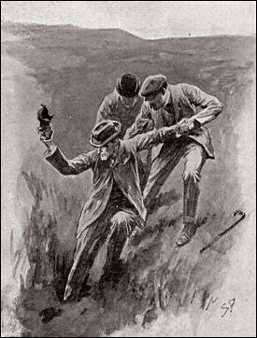
M.R. :They had to come up with an interesting name, and it comes from The Hound of the Baskervilles. Holmes pulls a lost boot from a bog and finds the maker’s label inside: ‘Myers Toronto.’ So they thought, ‘There’s your connection to Toronto,’ and they called the president Myers. We also have other boot‑related titles: the vice‑president is the Shoehorn, the treasurer is the Bootjack, the secretary is the Bootlace, and so on. Another unique thing is the music. We’ve always had someone write a song for each story. Jim Ballinger wrote a book called Sherlock Holmes in Song, with an original song for every story. After Jim moved away, we continued with parody songs using karaoke tracks. Karen Gold, who sings jazz, performs a parody song at every meeting. I’m trying to compile a book now — something like ‘Sherlock Holmes Karaoke’ — so other clubs can use it.”
G221B : What does the club look like today?
M.R. : During COVID we went online, and we were very successful. People from all over the world started joining our meetings — the US, England, France, Japan — and some of them became members. Now we do about five online meetings a year, and a couple of live meetings for our local members. We usually get between 50 and 60 people online. Some of our older members actually prefer online meetings because they don’t have to take the subway to the library.
G221B : would you say the club is primarily a circle of friends, a study group, a literary society, or a combination of all three?
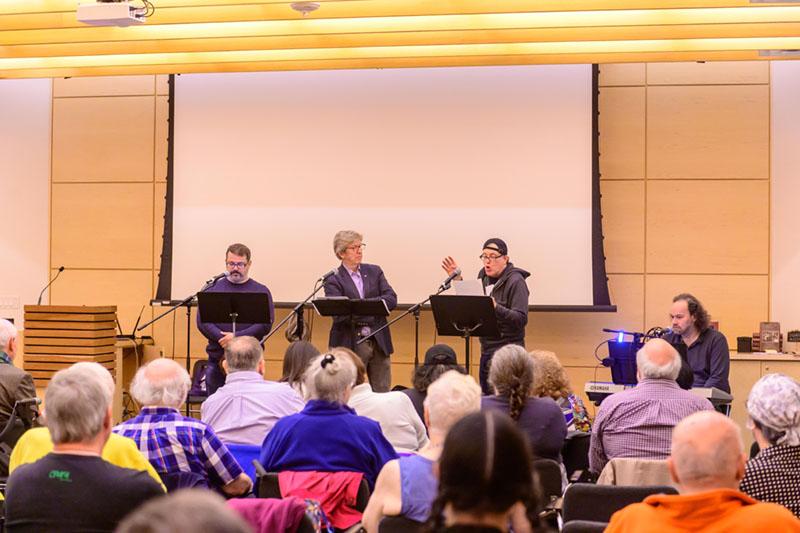
M.R. : It started out as a very literary club. We would read a story, have a quiz, and invite speakers. But we added music, games, humorous things, and even little plays. As the club grew, new members came in who may not be that literary — some know Sherlock Holmes from films or TV shows. So I try to keep a balance: something in depth, but also fun. You want to have something for everybody.
G221B : What activities do you organize throughout the year?
M.R. : We do regular meetings, presentations, songs, quizzes, and little plays. We collaborated with the Bata Shoe Museum for a special event. Sometimes we organize outings to Sherlock Holmes plays. We used to have the Silver Blaze event at the Toronto Race Track, but COVID and rising costs made it difficult. We also used to have a yearly Sherlock Holmes birthday dinner with the Blue Carbuncle Awards. Now we celebrate it online.
G221B : What does a typical meeting entail?
M.R. :Traditionally, we tell members to read a story before the meeting. We do a quiz, a presentation, a song, and sometimes a little play. Online meetings last about two hours without breaks, because otherwise people are just waiting in front of their screens.
G221B : Can you describe any special events or share details about one in particular?
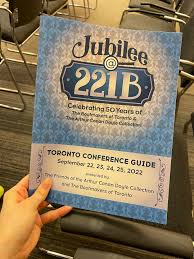
M.R. : At the Bootmaker Jubilee, we did a play with H.R. Thompson, a Canadian actor. It was my first time doing a big live event, and there was a lot happening. We also did an event with the Bata Shoe Museum. I wrote a Sherlock Holmes radio play, and we had presentations about shoes in the Canon.
G221B : Do you have any rituals, toasts, or honorary titles?
M.R. :Yes — the boot related titles, the songs at every meeting, the quizzes, and the Blue Carbuncle Awards. Those are long standing traditions, as of course, the historical connection with the Arthur Conan Doyle Collection at the Toronto Public Library.”
G221B : What role does the Canon play in your activities?
M.R. : The Canon is still central. We read the stories, do quizzes, songs, and discussions. But we also explore pastiches, modern adaptations, and other detectives — Lupin, Raffles, Solar Pons, Agatha Christie, Dorothy Sayers. This year I decided to focus on apocrypha and pastiches before returning to the Canon.
G221B : What means of communication or publication do you utilize?
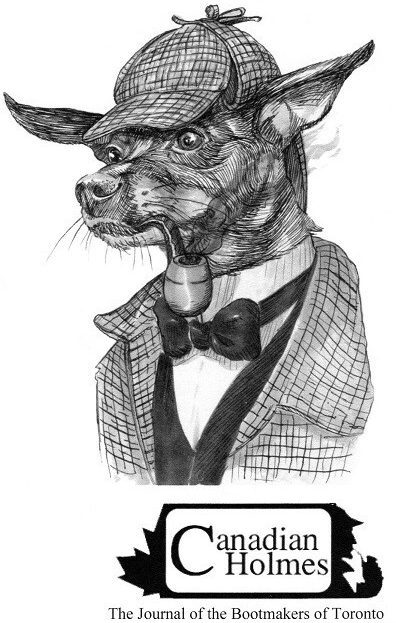
M.R. : We have Canadian Holmes, our publication. We’ve published a couple of books — one on the history of the Bootmakers, and a ‘best of’ anthology. Jim Ballinger’s songbook was published by MX Publishing. I’m working on a karaoke book.
G221B : What relationships do you have with other Sherlockian clubs in the country or internationally?
M.R. : Some clubs came out of the Bootmakers or were helped by us: one in Niagara, one in Montreal (The Bimetallic Question), one in London, Ontario (The Sesquipedalians), and one in Vancouver (The Stormy Petrels). We don’t get together much because the distances are huge, but we keep in touch. With online meetings, I can invite speakers from all over the world.
G221B : What challenges does a Sherlockian club face in the 21st century?
M.R. : It’s hard to get new members and younger members. Younger people are plugged into media, not the literary parts. People join later in life, usually in their 40s. There are so many online distractions. Clubs are aging. You need to have things for both the literary people and the media people.
G221B : What projects or developments do you envision for the coming years and what would you like the club to look like in ten or twenty years?
M.R. : Continuing hybrid meetings. Publishing the karaoke book. Inviting diverse speakers. Exploring more pastiches and related detectives I hope the club stays vibrant, with new members, keeping the balance between scholarship and fun, open to international members, and able to adapt to new forms of Sherlock Holmes culture.

