
by Robin Rowles

The Sherlock Holmes Society of London recently held its 75th Anniversary Symposium at Madingley Hall, Cambridge, from September 4th to 6th, 2026. Scholars and enthusiasts gathered to explore various aspects of the beloved detective’s world, featuring a series of intriguing presentations that delved into history, psychology, and interpretation of the Canon.
Catherine Cooke kicked off the symposium with a captivating history of ‘The Borough of Marylebone Sherlock Holmes Exhibition ‘, which took place in 1951, but which nearly didn’t happen! Initially intended to document changes in Marylebone since 1851, the concept was rejected, paving the way for a new idea: a celebration of Sherlock Holmes. The exhibition, which cost £3,500 (roughly £125,000 today), charged one shilling and twelve old pence for adults, with cheaper options for children. The exhibition ran until September 1951, and during that time, the present-day Sherlock Holmes Society of London was formed at the Victoria & Albert Museum in July 1951. The exhibits included 53 used pipes, manuscript copies of ‘The Retired Colourman’ and ‘The Dying Detective’, and binaural stethoscopes, which had been in use since 1851. The exhibition was widely promoted on cinema newsreels, as television sets were still a relative rarity in 1950s Britain.
Michael Homer then took the stage with ‘A Study in Scarlet: Shilling Shocker and Premier Canonical Story’; arguing that the first Sherlock Holmes novella is a disguised attack on Catholicism. Thus, in the second half of the story, Mormonism replaces Catholicism as the religion of fear and repression. The Mormon leader Brigham Young is the only historical figure to speak dialogue in the Canon. Jefferson Hope, as the outsider, is classified in the Mormon worldview as a Gentile. Arthur Conan Doyle consulted many sources in writing Study and parallels may be drawn to the European Wars of Religion that took place between about 1450 and 1750.

Then, Professor Roberta Pearson captivated the audience with her analysis of Holmes’ sentimental nature in “’ Sentiment, My Dear Watson’: Three 1970s Films on Holmes’ Human Heart”. Professor Pearson demonstrated that three films, The Private Life of Sherlock Holmes (1970), The Seven-Percent Solution (1976), and Murder by Decree (1979), “reproduced, attacked, and finally abolished the Holmes-Watson template that ‘Holmes cannot feel, Watson cannot understand ’ « . In fact, ‘intelligent’ Watsons started to appear from 1954 when Universal sold Holmes to television. As Professor Pearson notes, Sherlock Holmes ‘films were not inventing, just recovering something the Canon already contains’ and are an interpretation, not reinvention of the Canon. Casting choices played a crucial role, enabling actors like Colin Blakely and Robert Duvall to portray Watsons who could hold their own beside their iconic counterparts.
Bonnie MacBird’s talk, “Science, A Prince, and the Ladies of the Night,” tackled an ongoing debate: Did Holmes study at Oxford or Cambridge? Bonnie pointed out that Cambridge is more noted for science and mathematics, while Oxford excels in politics and law. However, Cambridge alumni have predominated in the ranks of Nobel Prize winners. Bonnie pointed out that Cambridge graduate Francis Bacon developed the scientific method: ‘Facts can only be discovered after much observation and the accumulation of knowledge’, which is familiar to fans of Sherlock Holmes. In the film A Game of Shadows, it is implied that Moriarty is a professor at King’s College, Cambridge. MacBird also highlighted some historical realities: there was resistance to women studying, as this was considered non-respectable. Women were allowed to take exams but were not awarded full degrees until 1948.
The symposium also had guest speakers from across the Atlantic. Among them, Monica Schmidt took the psychological approach, “Late of the 5th Northumberland Fusiliers: Dr John Watson’s Invisible War”. Monica notes that ‘Popular culture portrays John Watson as an empty vessel’. In the BBC’s Sherlock, JW is shown having Post-Traumatic Stress Disorder (PTSD) flashbacks. Did the canonical JW have PTSD? PTSD is a complex subject, and identifying it requires a closer diagnosis. JW was exposed to the double trauma of combat stress and a sense of personal helplessness. Following a simple timeline: in 1880, the Battle of Maiwand took place, and in 1887, the events in A Study in Scarlet took place. Yet it wasn’t until the First World War that the phrase ‘Shell Shock’ was coined. The diagnostic framework of PTSD is explainable through six domains: re-experiencing; avoidance; a persistent sense of threat; affect dysregulation; negative self-concept; and disturbed relationships. Monica illustrated these domains through the stories: Study, Sign, and Hound are novellas, and present a larger canvas where re-experiencing occurs. The characters Stamford from Study and Colonel Hayter from ‘The Reigate Squires’ indicate avoidance. The sense of persistent threat is shown by JW retaining his army revolver and vigils in the Canon, in ‘The Speckled Band’ and Hound, for example. Affect dysregulation is seen in ‘The Final Problem’; ‘The Empty House’; ‘The Three Garridebs’; and ‘The Devil’s Foot’. However, Monica noted the evidence was ‘suggestive but not conclusive’. JW’s marriages are counterevidence of him suffering affect dysregulation. Therefore, JW’s PTSD is less of a diagnosis than an explanation. JW was fighting a war that nobody else could see.
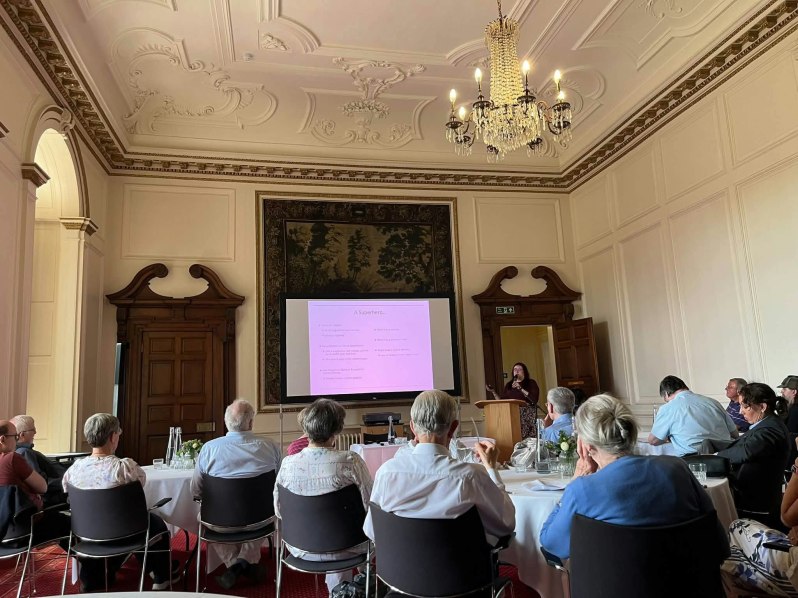
Johanna Draper-Coulson discussed “The Superhero – Sherlock” and posed the central question of her paper: what makes a superhero? ’. Johanna guided the meeting through a roll call of comic book heroes and used these to identify three common traits of heroes:
- Heroes have a sense of purpose and are concerned with justice, like Batman and Superman.
- Their appearance is unmistakable, unique, and iconic.
- Their crime-fighting activities are a contrast to their quiet, mundane lifestyles.
However, Sherlock Holmes is different; SH’s abilities are beyond normal. SH has a purpose and a sense of justice. His outfit is recognisable, one-of-a-kind, and certainly iconic. Yet SH doesn’t have a double life; his life is his work, and his work is his life. This raises SH above the pantheon of heroes and elevates him to superhero status. Eva Iggland then re-examined ‘The Blue Carbuncle ’ in her paper, “What is the Blue Carbuncle and Where did it go in the Goose?”. Carbuncles, credited with religious and mystical properties, were worn on priestly garments in the Bible. This introduction was followed by a scientific discussion of what a carbuncle is. Although they are in the ruby family, there are no pure blue rubies. She also proposed a timeline for James Ryder’s walk from his sister’s farm in Brixton to Kilburn, accounting for the time it would take to cut open the bird and make his wasted journey to Covent Garden Market. She estimated that the stone was inside the goose for at least ten hours before reaching the Alpha Inn; however, if it had been in the bird’s crop, it would have been expelled in approximately four hours. Therefore, it is more likely that the carbuncle was in the goose’s crop. Finally, Eva demonstrated the goose would have been delivered to the Alpha Inn, where Henry Baker briefly had possession of it, on 23 December. The landlord would not hand the geese over until Christmas Eve, otherwise his customers would trade their geese for drink, and their families would go hungry on Christmas Day. Therefore, we can place Henry Baker’s altercation on the corner of Goodge Street and Tottenham Court Road to the small hours on Christmas Day.
Finally, Thomas Hauser introduced his new book “Sherlock Holmes and Mrs Rutledge” and drew out the now popular theme that Sherlock Holmes and Arthur Conan Doyle were exhibiting racist sympathies. Purely by reading the Canon, one could make compelling arguments either way, with the caveat that attitudes that were perfectly acceptable one hundred to 140 years ago are viewed differently today. The jury is still out.

Ashley Mayo closed the presentations with his closing thoughts: “Sherlock Holmes went to Camford”, neatly sidestepping the debate between Britain’s two great universities while noting the existence of the ‘Varsity Line’ that ran from Oxford to Cambridge, via changing at Bletchley.
The contributions were engaging, well-documented, and thought-provoking. Most importantly, they demonstrated the impressive variety of perspectives inspired by Sherlock Holmes, from history and psychology to cinema, science, and a close examination of the original stories. Seventy-five years after its establishment, the Sherlock Holmes Society of London clearly shows that the Baker Street detective still has many secrets to reveal.

