Interview with Mark Jones and Paul Chapman, creators of Doings of Doyle
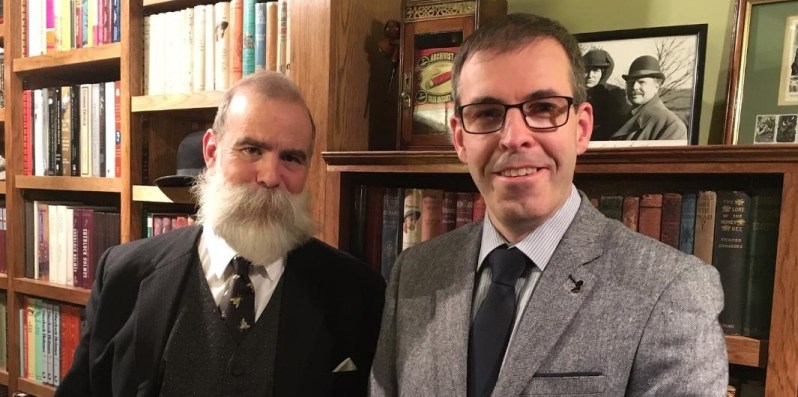
One thinks they know Conan Doyle because they know Sherlock Holmes. The detective from Baker Street seems to absorb all the light, leaving in the shadows a body of work that is immense, vibrant, and audacious, where gothic, fantastic, science fiction, exploration stories, historical fiction, and spiritual experimentation coexist. It is precisely in these shadowy areas that Mark Jones and Paul Chapman, two passionate Doyleans, venture, creators of the podcast Doings of Doyle. With them, we explored the fantastic side of Conan Doyle: a territory where mummies, specters, daring scientists, women with unsettling powers, visions of apocalypse, and deeply intimate hauntings intersect, and discovered just how much Doyle serves as an entry point to the entire culture of his time.
Two Trajectories, One Shared Passion
The first question for these scholars naturally concerned their journeys that led them to be passionate about Conan Doyle’s work. For Paul Chapman, it all began in the late 1980s. « I came to the universe of Holmes and Doyle like many others, through the series with Jeremy Brett, » he recounts. « I read the canon, and then I went further because I was already very interested in genre literature from the late Victorian and Edwardian periods. » According to him, at that time, Conan Doyle was not yet recognized as a writer in his own right; he remained imprisoned by the figure he had created himself. Paul then became a member of the Northern Musgraves Sherlock Holmes Society and got involved in the group’s mission: to rehabilitate Doyle, not just as the father of Holmes, but as a complete author with multiple facets. It was there he discovered the gothic, strange, and supernatural vein of the writer—a literary territory he would never leave. Mark Jones followed a parallel path. For him, too, it all began with adaptations: Basil Rathbone, then Jeremy Brett. After devouring Holmes’s adventures, he turned to The Lost World, and then to historical short stories. A historian by training, having taught for several years, he finds in Doyle’s works a fascinating mirror of Victorian and Edwardian culture. From this shared passion, Doings of Doyle was born, a podcast that has established itself as a reference for all those who wish to explore the complete works of the author. Their ambition is simple yet immense: to restore to Conan Doyle the place he deserves in literary history
A Consistent Writer in His Diversity
One might naturally wonder how being the creator of the character of Sherlock Holmes, a champion of logic, can seemingly be contradictory by writing ghost stories or tales of possession in parallel. For Mark and Paul, this coexistence is not an antagonism but a continuity. Mark speaks of a « force of narrative« : a way of holding the reader, imposing rhythm and tension, characterizing quickly and accurately, writing sharp dialogue, and giving a sense of event —qualities found both in Holmes’s investigations and in ghost stories. Paul emphasizes that the author himself likely would not have drawn a clear boundary between his gothic tales and his detective stories. « Some of the detective’s adventures play with the limits of genres. The Speckled Band, for example, could almost be a ghost story. » This porousness of genres is characteristic of the late 19th century, a time when literary categories remained flexible. Doyle moves from crime to gothic, from adventure to science fiction, with an ease that brings him closer to authors like Machen or Blackwood, while distinguishing himself through a clarity and stylistic vigor all his own.
And Remarkably Modern
This stylistic coherence, combined with an insatiable intellectual curiosity, explains why his fantastic tales still retain astonishing freshness today. Doyle is never heavy-handed, nor does he get bogged down in an overly ornate Victorian style: he writes with clarity, liveliness, and economy that makes him surprisingly modern. His stories are structured with an almost cinematic precision. His characters, even secondary ones, have an immediate presence. « Doyle would have been a great television screenwriter. » Mark asserts. This modernity explains why his fantastic stories resonate even today. They speak of science, belief, fear, progress, solitude, desire, and domination—universal, timeless themes. For instance, in The Poison Belt, the second adventure of Professor Challenger, Doyle imagines that the Earth passes through a toxic ether zone. This novella, written in 1913, showcases striking modernity : confinement, scarcity, the imminent end of the world, and philosophical inquiries about humanity’s place in the universe. Mark recalls rereading it at the beginning of the COVID pandemic: “We didn’t need to stretch our imagination to make the connection.”
Multiple Influences: Poe, Stevenson… and France
Doyle’s influences are manifold, but both Mark and Paul agree that the foremost name is Edgar Allan Poe, who emerges as a significant source for both detective fiction and the supernatural. Paul emphasizes that while Doyle borrows from Poe, he humanizes him: where Poe can seem distant, Doyle allows a gentler, faith-filled narrative to shine through. Between Poe and Doyle, Robert Louis Stevenson serves as a bridge: as a short story writer and novelist, Stevenson illuminates how Doyle constructs his short tales—Doyle was even flattered when one of his anonymous stories was mistaken for a text by Stevenson. The scope of influence extends beyond the Anglo-Saxon realm: Doyle was familiar with French and German literature. Paul mentions Maupassant (Le Horla), Daudet, as well as the duo Erckmann-Chatrian, “who have their roots in both fantastic fiction and historical fiction.” Mark adds that “there’s likely much to say about the French influences on Conan Doyle and his fantastic fiction since he read the French press, from which Wilkie Collins — ironically — drew his ideas as well.” This openness to foreign cultures is reflected in tales like The Leather Funnel, which evokes the figure of the Marquise de Brinvilliers, a historical character, or in the use of psychometry, a concept quite in vogue among certain esoteric circles in Europe. Doyle is not an insular author; instead, he stands at the crossroads of various traditions.
The Fantastic as an Intimate Laboratory…
One of the most fascinating aspects of Doyle’s fantastic work is how it reflects his own inquiries, doubts, enthusiasms, and sometimes anxieties. Mark emphasizes this point: “Doyle borrows a lot from his own experiences. Some narrators even carry a touch of misanthropy that seems to stem from him.” A constant in Doyle’s fantastic tales is the presence of doctors, scientists, and explorers. “He clearly has a knack for creating narrators that draw from his own experiences,” Mark explains. “These are not always exact replicas of Conan Doyle, but through these narrators, we catch glimpses of facets of his character that might not come across as well in his autobiography.” This autobiographical dimension is particularly visible in The Captain of the Polestar, a fantastic story yet one of Doyle’s most personal works. Inspired by his experience on an Arctic whaling ship, the text intertwines realistic observation, a chilling atmosphere, and spectral appearances. Solitude, coldness, and vast whiteness become mediums for a diffuse, almost metaphysical unease. Doyle explores the boundary between hallucination and the supernatural, between extreme fatigue and mystical vision. The story, written early in his career, already reveals an author capable of transforming lived experiences into literary material. Paul highlights this unique blend of rationality and romanticism. Doyle is a writer deeply influenced by the scientific advances of his time. The late 19th century witnessed the birth of microbiology, radiography, domestic electricity, radio waves, and experimental psychology. For a curious mind like his, these discoveries were gateways to the unknown that captivated him. However, a blend occurs within him—echoing Sherlock Holmes’s phrase: « art in the blood takes on the strangest forms. » This is, in a way, what happens in his own writing. He is the first in his family to embrace a scientific career, yet the romantic spirit is always present-infused with science and exploration. There’s also a more intimate dimension: his relationship with the supernatural. Contrary to popular belief, Doyle did not become involved in spiritualism because of World War I. “He had been interested since the 1880s,” Mark recalls. Arthur Conan Doyle would later become one of the most fervent advocates of spiritualism. In the 1880s and 1890s, Doyle still played with these themes. The Parasite and Playing with Fire depict psychic phenomena and mediums, but often with an ironic, sometimes even comedic distance. “He has fun with it, but he’s also testing ideas” Paul summarizes. Doyle’s journey into spiritualism is long and complex, and his fantastical tales bear witness to this evolution. « If one wants to study Conan Doyle’s spiritual journey, I would tell anyone to read his fantastic stories, » says Paul. « It’s absolutely central, and it is an integral part of his progressive engagement. Rather than writing a scientific article to convince the public, he stages his ideas in fiction. » Later, in the 1920s, the tone changes, and Sir Arthur becomes more proselytizing. Mark references The Land of Mist, where Doyle makes Challenger a convert to spiritualism: « It’s a straightforward piece of spiritualist propaganda. »
…But also as mirrors of the anxieties of their time.
One of the constants in fantastic tales, from their beginnings to the present day, is their ability to elevate the anxieties of their time. Notable examples include Bram Stoker’s Dracula, which echoes fears of invasion by the foreign, and The Strange Case of Dr. Jekyll and Mr. Hyde, which reflects concerns about the excesses of science, alongside the fascination for the « new woman. » a powerful and unsettling figure embodied by Carmilla, the vampire created by Sheridan Le Fanu. Doyle’s fantastic stories do not escape this rule; they reflect the tensions of Victorian and Edwardian society. Stories like Lot No. 249 and The Ring of Thoth express a fear of the « backlash » of colonialism. Mark cites the concept of « imperial gothic » developed by Patrick Brantlinger: « It’s the theory that there existed a kind of imperial guilt, and that all the writers of the 1880s and 1890s began to disseminate this guilt in their works. There is some truth to this, but we shouldn’t exaggerate the idea that Conan Doyle was a fervent imperialist. I don’t believe he felt particularly guilty about the territories of the British colonies or their inhabitants. » Paul adds nuance: « Regarding imperial gothic, I tend to think it’s overstated, because for many writers of this kind, it’s a matter of exoticism, and I think that’s what plays a role in many of these stories, especially by authors like Conan Doyle or Rider Haggard. It’s more like, ‘Here are the dangers of these worlds, and it’s a good thing we are here to keep them under control.' » On the other hand, they readily acknowledge that some more personal anxieties surface, particularly in The Parasite or John Barrington Cowles, where powerful, hypnotic, and dangerous female figures appear. « The anxieties are there, » says Paul. « The New Woman, the emancipated woman, the fatal woman – Miss Penclosa, Kate Northcott – all of this is part of that period. Doyle clearly projects something of himself into these characters.”
| Entry Points into Doyle’s Fantastic World When I ask them which stories they would recommend to a reader wishing to discover this facet of Doyle’s work, Mark and Paul hesitate—not due to a lack of ideas, but because choosing is a heartbreaking task. Mark first mentions The Captain of the Polestar, a tale enriched by Doyle’s Arctic experiences, where solitude, ice, and silence create a backdrop of rare intensity. He then refers to Lot No. 249, one of the finest mummy stories ever written, whose breathless pace evokes the investigations of Holmes. Finally, he highlights The Case of Lady Sannox, a grotesque tale of nearly unbearable cruelty, showcasing Doyle at the height of his Gothic artistry. Paul agrees with two of these choices and adds The Leather Funnel, a profoundly unsettling story related to psychometry and rooted in French history. He emphasizes the symbolic richness of this text and its ability to blend history, psychology, and horror. And, since Sherlock Holmes cannot be completely forgotten, both men recommend The Hound of the Baskervilles, which, despite its status as a detective story, is also one of Doyle’s most beautiful Gothic tales |
Conclusion
As the conversation unfolds, one conviction emerges: while Sherlock Holmes remains an inexhaustible character, he should no longer overshadow the entirety of Arthur Conan Doyle’s work. “We thought the battle was won,” admits Mark, referencing a recent BBC ranking of the 100 greatest British books, in which Doyle is absent. “Apparently, it’s not. We still have work to do.” But Mark and Paul pursue this work, episode after episode, text after text, demonstrating that Doyle is not only a great author of detective stories but also one of the key architects of modern fantasy. He was a writer who captured the anxieties of his time, transformed them into gripping narratives, and opened paths that others—such as Lovecraft or Robert E. Howard—would later follow.

